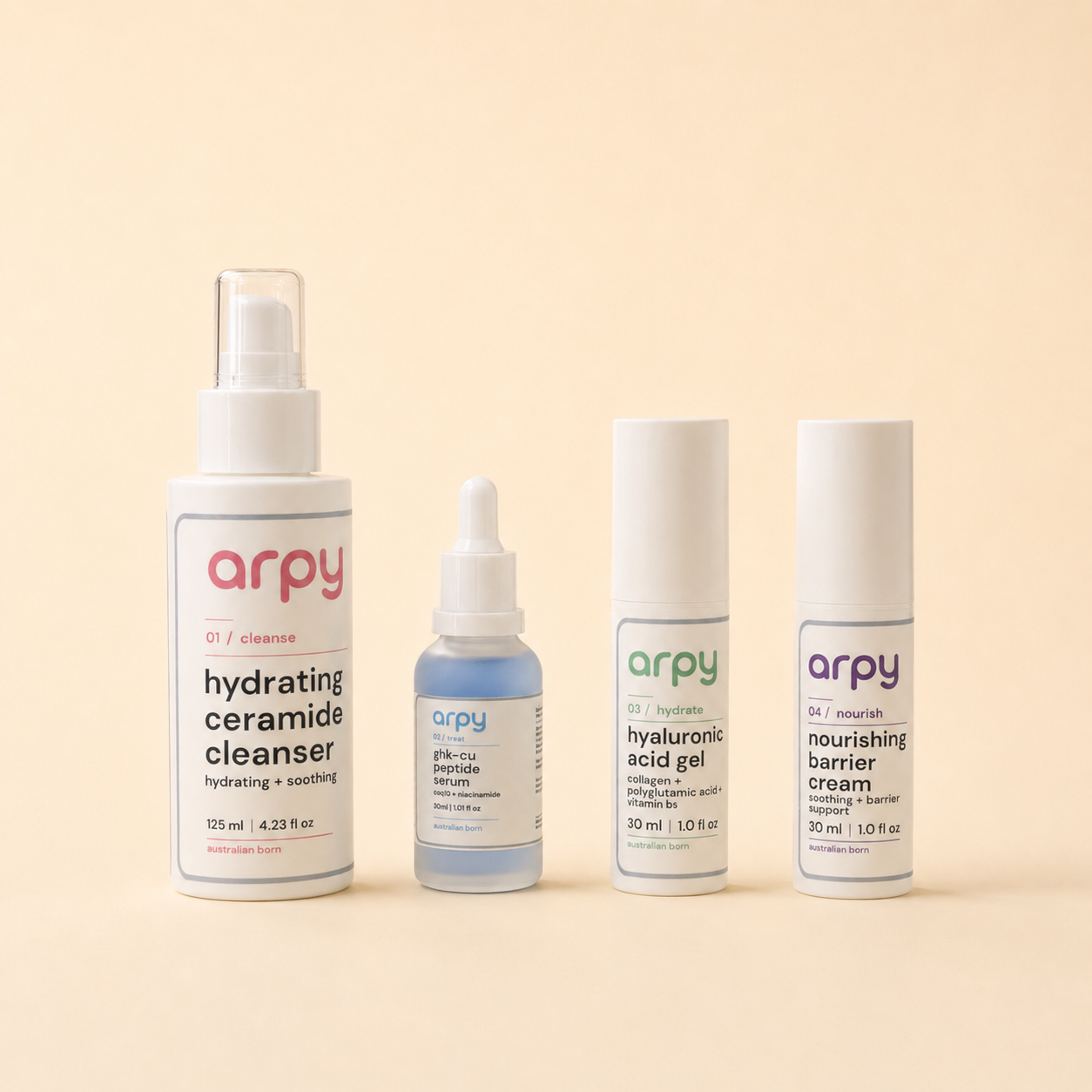
written by Riley Tonks, co-founder of arpy, 15 October 2026
ghk-cu is the copper peptide most people mean when they search for a copper peptide serum. it's also one of the most confusing ingredients to compare, because the percentage on the label doesn't always mean what it looks like it means.
this guide is about topical ghk-cu, the kind in a serum you put on your skin. it covers what ghk-cu is, how to read the number on a label, what it does and doesn't do, how to choose one in Australia, and what's in ours.
a bit about us: Matt and I started working on arpy in Newcastle in January 2026, and the copper peptide serum is the product people ask us about most. this is the guide we wish we'd had when we started comparing labels.
the short version
- ghk-cu, copper tripeptide-1 and copper peptide are the same ingredient.
- "1% ghk-cu" on a label often means 1% of a pre-made 1% solution, which is about 0.01% real peptide.
- ours is 0.2% pure ghk-cu, made from powder: about 20 times the real peptide of that "1%".
- use 3 to 4 drops after cleansing, every day, morning and night.
- it's for smoother, firmer-looking skin. that's all we claim.
what is ghk-cu?
ghk-cu is a small peptide, made of three amino acids (glycine, histidine and lysine), bound to copper. on an ingredient list you'll see it as copper tripeptide-1. same thing, different name. "copper peptide" is the everyday name for it, so a copper peptide serum and a ghk-cu serum are usually the same kind of product.
ghk was first described by researchers in the 1970s, and it has been studied in labs for decades since. in skincare, it's used in serums for skin that looks smoother and firmer. that's what we use it for, and it's all we claim for it.
why is ghk-cu serum blue?
the copper. ghk-cu is what gives copper peptide serums their blue colour. ours is a clear, runny blue. if a serum says it contains a lot of ghk-cu but has no colour at all, that's worth a question to the brand.
what "1% ghk-cu" usually means
here's the part most people don't know.
ghk-cu is almost always supplied to brands as a pre-made 1% solution. so when a label says "1% ghk-cu", it can mean 1% of that solution went into the formula. 1% of a 1% solution works out to about 0.01% actual peptide in the bottle.
that isn't necessarily wrong, but it isn't the same thing as 1% ghk-cu.
so if you're comparing serums, the question to ask is simple: is that percentage the solution, or the peptide?
what's in ours
our copper peptide serum contains 0.2% pure ghk-cu.
we use pure ghk-cu powder rather than a pre-made solution, so 0.2% is the real amount of peptide in the bottle. that's about 20 times the actual peptide of a "1%" serum made from the pre-made solution.
alongside it are niacinamide (vitamin B3) and Q10. it comes in a 30 ml bottle, and it has a light japanese honeysuckle scent.
every batch is made on the Gold Coast.

arpy copper peptide serum
0.2% pure ghk-cu (copper tripeptide-1), niacinamide and Q10. 30 ml, made on the Gold Coast. $59, with our 30-day money-back guarantee.
does ghk-cu serum really work?
it depends what you mean by work, and that's where a lot of the confusion comes from.
most of the research on ghk-cu is lab work and small studies. online, you'll read much bigger claims than that research supports. we don't repeat them, and we'd be careful of any brand that promises a lot.
what we can tell you is what we see with our own serum: after it, skin looks dewy and feels hydrated, and with daily use it's there for skin that looks smoother and firmer. that's the honest version, and it's the only one we put our name to.
the fairest test is your own skin. that's why the serum comes with a 30-day money-back guarantee.
what does ghk-cu serum help with?
in a skincare routine, a ghk-cu serum is for how skin looks and feels: smoother, firmer-looking skin, and a dewy, hydrated feel straight after you put it on.
it's a cosmetic, not a treatment. if you have a skin concern you're worried about, a GP or dermatologist is the right person to ask, not a serum label.
which ghk-cu serum is the best in Australia?
we make one, so we're biased. instead of telling you ours is best, here's what we'd check on any ghk-cu serum before buying it:
- the real percentage. is the number on the label the amount of peptide, or the amount of a pre-made solution? if a brand doesn't say, ask.
- pure peptide or solution. a serum made from pure ghk-cu powder can tell you the real amount in the bottle.
- the colour. ghk-cu is blue. a serum with real copper peptide in it usually is too.
- what else is in it. check the full ingredient list.
- where and how it's made. who makes it, and where. "made in Australia" is easy to check on the label.
- the price per ml. bottle sizes vary, so compare like with like.
- what happens if it isn't for you. a clear money-back or returns policy tells you how much the brand stands behind it.
here's ours against that list: 0.2% pure ghk-cu from powder, blue, with niacinamide and Q10, a light japanese honeysuckle scent, made on the Gold Coast, 30 ml for $59, and a 30-day money-back guarantee.
how to use a ghk-cu serum
- after cleansing, put 3 to 4 drops on your fingertips and press them over your face. that's enough for the whole face.
- use it every day, morning and night.
- follow it with something hydrating, then a cream. in our routine that's the hyaluronic acid gel and then the nourishing barrier cream.
- in the morning, sunscreen goes on last.
- if you're trying it for the first time, a small patch test first is worth doing. if anything stings or doesn't feel right, stop using it.
there's more on the order, and why it goes thinnest to thickest, in our guide to the four-step routine.
common questions
can you use ghk-cu serum every day?
yes. ours is made to use every day, morning and night, 3 to 4 drops each time.
can you use ghk-cu with vitamin C or retinal?
yes, you can use our copper peptide serum on the same night as our vitamin C serum and our peptide eye cream, which contains retinaldehyde, a form of vitamin A. on those nights, the copper peptide serum goes on first after cleansing, then the vitamin C serum, then the eye cream, then the gel and the cream. both extras start at two or three nights a week, and if anything stings, stop and give your skin a break.
how much ghk-cu serum should you use?
3 to 4 drops covers the whole face. more isn't better; the serum is thin and runny, so a few drops spread a long way.
how should you store ghk-cu serum?
ours doesn't need to go in the fridge. use it within 12 months of opening.
is ghk-cu the same as copper peptide?
in skincare, yes, almost always. ghk-cu, copper tripeptide-1 and copper peptide are three names for the same ingredient. copper tripeptide-1 is the name you'll see on an ingredient list.
does ghk-cu serum smell?
ours has a light japanese honeysuckle scent.
can you use ghk-cu with niacinamide?
yes. ours already has niacinamide (vitamin B3) in the same bottle, alongside the copper peptide and Q10.
is ghk-cu the same as other peptides?
no. "peptide" covers lots of different molecules. our peptide eye cream, for example, uses palmitoyl tetrapeptide-7, palmitoyl tripeptide-1 and palmitoyl tripeptide-38, which are different peptides. ghk-cu is the one bound to copper, which is why it's blue.
can men use ghk-cu serum?
yes. nothing in it is made for one gender, and the whole arpy range is for anyone who wants a simple routine.
is a higher percentage always better?
not automatically. what matters most is knowing the real amount you're getting, and a formula you'll actually use every day. that's why we put the real number on the bottle's page instead of a bigger-looking one.
where to get it
our copper peptide serum is $59 for 30 ml, and it's step 02 of the core four, our four-step routine in one box. every bottle comes with our 30-day money-back guarantee, and we ship across Australia, free on orders from $50.
if you have a question about it, email hello@arpyskin.com. i read every one.
sources
- Loren Pickart and Anna Margolina, "Regenerative and Protective Actions of the GHK-Cu Peptide in the Light of the New Gene Data", International Journal of Molecular Sciences, 2018. https://pmc.ncbi.nlm.nih.gov/articles/PMC6073405/